 Contested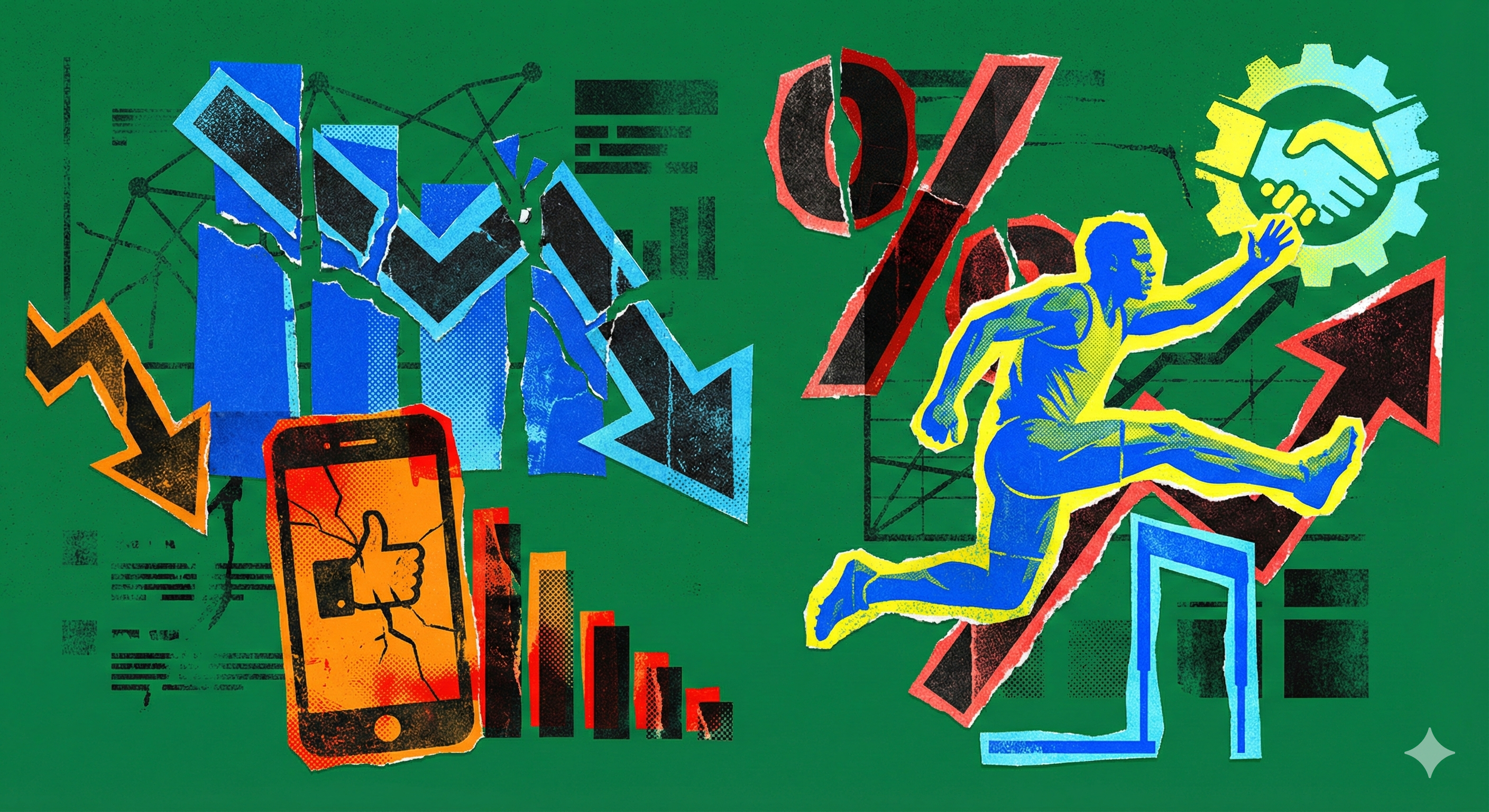
The 1.59% Problem: Why Influencer Engagement Rates Are Collapsing and What to Do About It
Instagram engagement is down 24% YoY. Macro-influencers average just 1.4%. Meanwhile, athletes deliver 5.6% engagement at a fraction of the cost. The data on why brands are shifting to athlete partnerships.
The average Instagram influencer engagement rate has been in freefall. In 2020, nano-influencers averaged around 4.5% engagement. By 2025, that number had dropped to just below 3%. Micro-influencers fell from roughly 3.5% to 2.5%. Mid-tier influencers declined from about 2.7% to under 1.8%. And macro-influencers — the tier where most brand budgets still concentrate — slipped from nearly 2.2% to around 1.4%.
The overall average engagement rate on Instagram in 2025? 0.50%. That's not a typo. Social Insider's analysis of 35 million Instagram posts found engagement down approximately 24% year-over-year, with static image engagement dropping 17% alone. Buffer's tracking showed Instagram's median engagement rate cratering from 2.94% in January 2024 to 0.61% by January 2025.
Meanwhile, brands are spending more than ever. The global influencer marketing industry hit $32.55 billion in 2025. Brands are pouring record budgets into a channel that is returning less engagement per dollar every quarter. That's the 1.59% problem — the weighted average engagement rate across mid-tier and macro influencer tiers where most brand spend concentrates. Every year the number drops. Every year the spend goes up. At some point, the math stops working. The question isn't whether influencer engagement is declining. It's what you do about it.
The Structural Decline Is Real (Not a Blip)
It would be comforting to dismiss the engagement drop as a temporary algorithm shift or a measurement artifact. It's neither. The decline is structural, driven by forces that aren't reversing.
Content saturation has reached critical mass. More creators are producing more content than ever. Nano-influencers alone make up 75.9% of all Instagram influencers, and brands are working with 33% more micro-influencers year-over-year. Add AI-generated content flooding every platform, and the result is a supply-demand imbalance where human attention can't keep up with content volume.
Platform algorithms now prioritize discovery over community. Instagram and TikTok increasingly surface content from accounts users don't follow, which boosts reach metrics but dilutes engagement. Your posts now compete against a functionally infinite content library, delivering more impressions but fewer interactions per impression.
Commercial density has eroded trust. When every third post in a feed is sponsored, audiences develop pattern blindness. They scroll past branded content the same way they skip pre-roll ads. Only 5% of consumers completely trust influencer recommendations, and trust is declining year over year.
Fraud continues to distort the market. Roughly 18% of influencer engagement is still artificial, costing brands an estimated $1.6 billion globally in 2025. Nearly half of Instagram influencers have engaged in fraudulent activities like purchasing followers or engagement. These aren't temporary headwinds. They're the mature-phase dynamics of a channel that grew faster than its quality controls could keep up.
The Platform-by-Platform Breakdown
Instagram: The overall average engagement rate dropped to 0.50% in 2025, down roughly 24% year-over-year. The median fell from 2.94% (January 2024) to 0.61% (January 2025). Even Reels — once the format reviving Instagram engagement — have plateaued.
TikTok: Still the highest-engagement platform at a 4.86% average, but the median declined from 5.14% (January 2024) to 4.56% (January 2025) as the platform matures and watch time is prioritized over interactions.
Facebook: Averaged 0.15% engagement in 2025, with gradual declines through the year as the algorithm deprioritizes brand content.
X (Twitter): Engagement slid from 0.15% to 0.12% — already the lowest major platform, continuing to erode.
The pattern is consistent: every major social platform is delivering less engagement per post, per follower, per dollar spent. Brands operating on 2019–2020 assumptions are running outdated math.
What This Means in Real Dollars
Declining engagement rates aren't just a vanity-metrics problem. They directly impact cost-per-engagement, cost-per-acquisition, and campaign ROI.
Consider a simplified scenario. A brand pays a macro-influencer $5,000 for a sponsored post. In 2020, at a 2.2% engagement rate on 500,000 followers, that post generated roughly 11,000 engagements — a cost of $0.45 per engagement. In 2025, at 1.4% engagement, the same post generates about 7,000 engagements — a cost of $0.71 per engagement. That's a 58% increase in cost-per-engagement even if the influencer's fee stayed flat. And fees haven't stayed flat.
Layer on the fraud problem — if 18% of engagement is artificial, the real cost-per-genuine-engagement is even higher. A brand paying for 7,000 engagements may actually be reaching 5,740 real interactions. That pushes the effective cost-per-engagement to $0.87. Multiply that across a 12-month influencer program with 20–30 partners and the budget erosion becomes significant.
The Athlete Engagement Advantage: Why the Numbers Are Different
While influencer engagement rates have been declining across every tier and platform, athlete engagement rates have held structurally higher. Athletes deliver an average social engagement rate of 5.6%, compared to ~1.9–2.4% for traditional influencers. At 5.6% versus the macro-influencer average of 1.4%, athletes deliver engagement roughly four times higher than the influencer tier where most brand spend concentrates.
Athletes earned their audiences before they monetized them. Growth and commercialization happened sequentially, not simultaneously, so audiences aren't conditioned to filter out branded messages.
Athletic credibility transfers differently than content credibility. When an athlete endorses a product, the endorsement carries the weight of witnessed achievement — a credibility premium no content strategy can replicate.
Athlete audiences are more resistant to content saturation. Lower post frequency and lower commercial density mean each partnership gets more attention per impression.
The Cost Comparison: Athletes vs. Influencers
A micro-influencer with 25,000 followers, charging $500 per post, delivering 2.5% engagement generates approximately 625 engagements. Cost-per-engagement: $0.80.
A college athlete with 15,000 followers, partnering for $400, delivering 5.6% engagement generates approximately 840 engagements. Cost-per-engagement: $0.48. The athlete partnership delivers 34% more engagements at 40% lower cost-per-engagement — and it comes with a trust premium the influencer post doesn't carry.
The Trust Premium
Cost-per-engagement captures quantity, not quality. Roughly half of consumers believe most influencer product reviews are fabricated, and only 5% completely trust influencer recommendations. In contrast, 80% of fans say they're more likely to trust an athlete's recommendation, and three in four perceive athlete endorsements as more authentic. That trust premium lifts conversion rates, brand recall, and long-term brand equity — and it's not subject to the same decay curve as influencer trust.
What Smart Brands Are Doing Differently
- Reallocate 20–30% of influencer budget to athlete partnerships. Run a parallel channel with higher engagement and stronger trust while keeping influencer learnings intact.
- Match on audience alignment, not follower count. Geo, demo, interests, and values beat raw reach.
- Run athlete partnerships as a performance channel. Promo codes, UTM links, dedicated landing pages, and CPA/CPE tracking.
- Prioritize long-term ambassadorships over one-off posts. Repetition compounds trust.
- Pair athlete credibility with creator production value. Athletes provide the authentic endorsement; creators optimize the content.
The Infrastructure That Makes This Possible
Traditional influencer platforms were built for content creators, not athletes. They don't solve for geographic audience concentration, NIL deal documentation, or sport-specific brand fit. Contested was built for this specific gap: intelligent athlete-brand matching, end-to-end campaign management, deal docs and FTC disclosure templates, and performance analytics designed for how athlete partnerships actually generate value. Contested does not provide compliance services.
The Engagement Rate Won't Fix Itself
The forces driving engagement decline — content saturation, algorithm evolution, trust erosion, commercial density — aren't cyclical. Engagement rates will continue to compress and costs per engagement will continue to rise. Athlete partnerships aren't a silver bullet, but they offer something increasingly rare in digital marketing: an audience that trusts the endorser, engagement rates that outperform by multiples, and pricing that hasn't yet caught up to the performance data.
The 1.59% problem isn't going to solve itself. The brands that build an alternative channel now — while the pricing window is still open — will look back on this moment the way early Instagram advertisers look back on 2014: as the obvious opportunity most people were too slow to act on.
Contested is the athlete partnership platform for brands ready to move beyond collapsing influencer engagement rates. Match with athletes whose audiences align with your customers, run every partnership in one place, and measure real performance. Get started at Contested.com
Sources
- SocialPilot — Instagram engagement rates 2020-2025
- Popular Pays — Overall Instagram engagement rate 0.50% in 2025
- Social Insider — 24% YoY Instagram engagement decline
- Buffer — Instagram median engagement drop 2024-2025
- Social Insider — Social media benchmarks across platforms
- SocialRails — Engagement benchmarks 2025
- Influencer Marketing Hub — $32.55B influencer spend 2025
- Archive.com — Influencer pricing and brand preferences
- Stack Influence — Creator volume and micro-influencer growth
- BBB National Programs — Influencer trust index
- Morning Consult — Influencer trust decline
- Influencers-Time — Estimated 18% fake engagement
- AdMonsters — Fraud and artificial growth
- Amra & Elma — Brand concerns about fake influencers
- MWW — Athlete engagement rate 5.6%
- OpenSponsorship — Athlete vs influencer engagement and trust
- OC&C — NIL deal values
- RallyFuel — Average NIL deal values
- Paint Touches — NIL median values
- On3 — Women's NIL median deal value
- Harvard Business Review — Consumer skepticism of influencers
- Clutch — Purchase behavior from influencer recommendations
- Rival IQ — 2025 social media industry benchmark report